NEW YORK CITY RELEASES 9/11 AIR QUALITY DATA
https://sept11documents.cityofnewyork.us/
https://nydailynews.com/toxin-documents-scrutiny-of-giuliani-bloomberg
Release of NYC 9/11 toxin documents ratchets up scrutiny of Giuliani, Bloomberg
by Josephine Stratman / September 8, 2026
“Mayor Mamdani said Tuesday New Yorkers were “lied toâ€� about the dangerous air quality in the aftermath of the 9/11 attacks — though he declined to explicitly pin the blame on past mayors. A tranche of long sought-after documents was released Tuesday, with the 25th year since the attacks just days away. After a multi-year legal battle, around 170,000 pages of documents were put online for public viewing, with more uploads to follow as the city reviews more documents, Corporation Counsel Steve Banks said. “People got sick because the leaders they trusted lied and told them they were safe to breathe in toxic air,â€� Mamdani said at a City Hall press conference announcing the release of the documents. “And then when they began to contend with the symptoms of the illnesses that followed, the government that had not hesitated to send them into harm’s way was nowhere to be found.â€�
Mamdani repeatedly declined to name names. The roles of Mayors Giuliani and Bloomberg are coming under increasing scrutiny as more information emerges about the degree of awareness there was about toxins in the air as New Yorkers were told it was safe to return to lower Manhattan. The roles of Mayors de Blasio and Adams are also coming under review as advocates criticize the continued secrecy at City Hall for failing to make public information that could have saved lives as more and more responders fell ill with 9/11-related illnesses.
Federal officials, including Christine Whitman, who headed the head of the Environmental Protection Agency under then-President George Bush, told the public the air around Ground Zero was safe to breathe, are also again coming under the spotlight. She apologized for the messaging years later. “I wish there was a limited number of people who misled the public that I could describe them in just a few names, but the truth is that, as we have heard, this goes across a multitude,� Mamdani said. Congressmember Jerry Nadler, whose district in 2001 included Ground Zero, said he had pushed both the Giuliani and Bloomberg administrations to release what information they had about the dangerous air quality. “I was screaming at the top of my lungs to protect our communities, my constituents, but officials like EPA Administrator Christine Todd Whitman and Mayor Giuliani denied claims like mine, saying the air was perfectly safe,� Nadler said. “Blasphemous!�
Dust hung in the air for months after the attack — but city and federal officials told New Yorkers things like “everything down here is just perfectly safe,“ an EPA spokesperson said in 2001, in the immediate aftermath of the attacks. A spokesperson for Bloomberg declined comment. A spokesperson for Giuliani, who of late has attacked Mamdani for his Muslim faith and called on him not to attend the 9/11 Memorial ceremony Friday, did not immediately respond to a request for comment. Many estimates put the number of those who have died due to 9/11 related illnesses at about 6,000. The NYC Health Department’s World Trade Center Health registry places the number at 9,000— triple the number of those who perished in the attack that day. The documents released Tuesday include the so-called “Harding memo� from Giuliani’s Deputy Mayor Robert Harding to an aide in October 2001, where he described the various possible litigation the city could face after the attacks, including “toxic tort cases that might arise in the next few decades.�
There are also pages showing that buildings in the area, including Deutsche Bank at 130 Liberty Street, received test results showing above dangerous levels for asbestos and other carcinogens. The records include a batch of documents stored in 68 boxes that the city had said they lost in a Department of Environmental Protection office, as well as papers sent to an insurance company called Captive and documents sent for archival by the Giuliani administration. The release of the documents comes as the city’s Department of Investigation looks into the city’s response. The release of the documents is part of a settlement agreement for a lawsuit brought by 9/11 Health Watch, which sued to release the documents.”
 “Unearthed memo shows NYC officials feared
toxic exposures just one month after 9/11″
LEGISLATIVE ALTERNATIVES to LIMIT the CITY’s LIABILITY for 9/11
https://911healthwatch.org/files/Court-Submission-20260205.pdf
https://nydailynews.com/9-11-documents-show-how-dangerous-air-was
Long-sought 9/11 toxin documents show NYC knew within weeks how dangerous the air was
by Thomas Tracy / September 8, 2026
“Long-sought pivotal documents about the toxins swirling around Ground Zero after 9/11 were released to the general public Tuesday, showing NYC officials knew within weeks of the towers’ collapse that the air quality in lower Manhattan was hazardous to those living there and who responded to the terror attacks 25 years ago. “There are clear indications (that the city) knew there was problem with air quality,â€� City Corporation Counsel Steven Banks said Monday in a press briefing ahead of the documents’ release via an online portal. “City officials knew there was a problem with the air quality, and there are records that demonstrate that and have not been released for years.â€� Not only did the city know about the dangers, but within three months of the attack the city had collected, scanned and archived documents pertaining to the terror attack and the aftermath, including records about air quality — documents that have become the centerpiece in a long-running battle.
Those documents were then sent to an insurance company called Captive for safekeeping in case of any potential litigation, Banks said. Sending the documents to Captive gave the city cover to argue they didn’t have the documents when responding to Freedom of Information requests. The “missing� air quality reports were potentially critical pieces of information as people who lived and worked around Ground Zero became ill. An estimated 6,000 first responders, survivors, and volunteers have died of a 9/11-related illness over the last two and a half decades — double the number who died in the initial terror attack. The New York City Health Department’s World Trade Center Health Registry puts the number of 9/11-illness fatalities at 9,000. More than 145,000 people have enrolled in the World Trade Center Health Program. Out of that number, about 81,000 have a certified medical condition linked to the toxins that hung above Ground Zero.
The opening of the online portal comes four days before the city marks the 25th anniversary of the Sept. 11 terror attacks and three years to the day when 9/11 Health Watch submitted a Freedom of Information Law request to the Adams administration for the documents. The city’s claims that they had no documents to share led to a lawsuit filed by Benjamin Chevat, the executive director of 9/11 Health Watch and his attorneys Andrew Carboy and Matthew McCauley. That lawsuit was also settled Tuesday. About 170,000 of the documents were set to be released publicly through the online portal Tuesday. Most of them will be the hard copy documents found in 68 boxes in the city’s Department of Environmental Protection that were discovered as the city battled 9/11 Health Watch’s lawsuit.
The documents indicate that city agencies were still finding evidence of asbestos in lower Manhattan within 10 months after the terror attack — long after Mayor Giuliani and federal officials said that the air quality around Ground Zero was safe, according to the New York Times. “(The city) began covering their ass three weeks in,� “Daily Show� host Jon Stewart, a longtime advocate for 9/11 first responders, said at Tuesday’s press conference. “They didn’t recognize that the air that everyone was breathing in downtown Manhattan was toxic until October of 2001. So to be fair to them, they only buried that information for 25 years.�
More documents will be coming now that the city has recovered them from Captive, Banks said. While applauding the “fresh commitment to transparency� by Banks and the Mamdani administration, Carboy said the “city’s reversal is no reason for celebration. The September 11th community expects the government to obey the law, and not willfully defy it for a quarter century,� Carboy said. “Our lawsuit demonstrated city staffers behaved more like members of an authoritarian regime than public servants. Career officials ‘forcibly disappeared’ the archive, resisting its disclosure and denying its existence,� Carboy said. “Not even sitting members of the City Council or the U.S. Congress could access these records.�
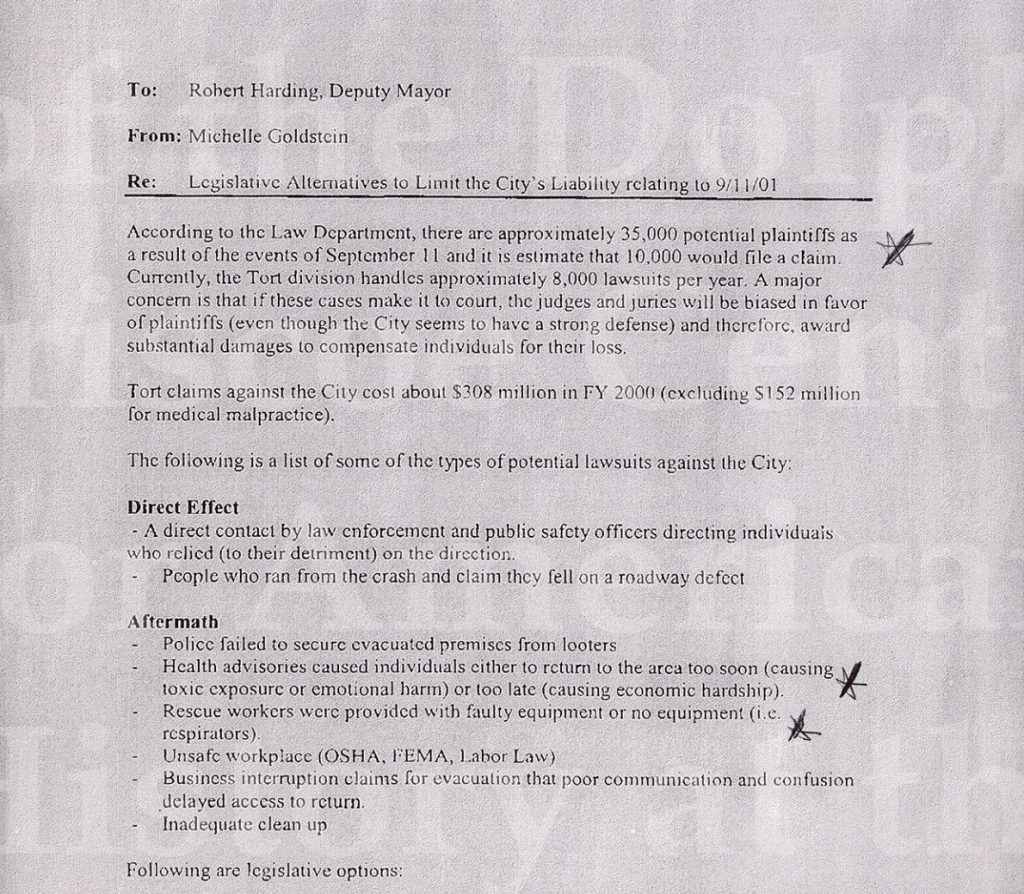
The documents released Tuesday include the long sought-after “Harding Memo� written in October 2001 that proves the city was worried that thousands of first responders and survivors could potentially suffer from “toxic exposure� at Ground Zero. Additional documents will be added on a rolling basis in the coming months, Banks said. “For too long, New Yorkers have had to fight for access to records that should have been available to them in the first place,� Mayor Mamdani said in a statement. “This portal is part of our administration’s enduring commitment to honor those we lost, care for those living with lasting health consequences and give thousands of New Yorkers the answer they’ve been asking for.�
As part of the settlement. the city will pay 9/11 Health Watch’s court costs, fully support the ongoing DOI investigation to find out what the city knew about the deadly toxins floating above the destroyed Twin Towers and improve access to records needed by those enrolled in the World Trade Center Health Program and September 11th Victim Compensation Fund — federal programs that provide health care and compensation for those with a 9/11 illness — to establish their presence at Ground Zero. The city has also agreed to promote awareness and participation in the upcoming World Trade Center Health Program’s Youth Research Cohort, which will study illnesses that may have developed among those who were minors or in utero during the aftermath. Chevat, Carboy and McCauley will be meeting with the city monthly for the next year to make sure that the portal is still producing the correct documents and fine tune the search parameters. If any disputes arise on how the documents are being disseminated, they have the right to bring their concerns to New York Civil Court Judge James Clynes, who will be able to reopen the case.
“For 25 years, four different Mayoral administrations kept from the public, the U.S. Congress, and the City Council documents showing what the city actually knew about the danger of the toxic chemicals in Lower Manhattan and Western Brooklyn after the World Trade Center collapse, even as city officials continued messaging to the public that the air was ‘safe and acceptable,’â€� Chevat said Tuesday. “I want to thank Mayor Mamdani for being the Mayor, after 25 years, who finally begins to answer the question, ‘What did the City know about the dangers from the toxic cloud at Ground Zero and when did it know it?’â€� “It just shouldn’t be this hard,â€� McCauley said about the fight to get these pivotal documents. “(But) our team is formidable and backed by an unbeatable and relentless 9/11 Community. It is clear the city saw that and took the path that respects the community, rather than stonewalling it like previous administrations.â€�

WORLD TRADE CENTER CAPTIVE INSURANCE COMPANY
https://wikipedia.org/wiki/World_Trade_Center_Captive_Insurance_Company
https://nydailynews.com/nyc-finally-coming-clean-on-secret-wtc-records
NYC finally starts coming clean on secret WTC records
by Michael Aronson / September 9, 2026
“With the start of the release of hidden World Trade Center 9/11 documents held by New York City, we can begin to understand the critical questions of who knew what and when about the environmental health disaster released when the twin towers fell and the soaring plume of white dust rose, covering Downtown. Mayor Mamdani and the city’s top lawyer, Corporation Counsel Steve Banks, were correct to stop the city’s resistance and finally publish the records, which should be complete within a year. The killer was that plume, filled with pulverized concrete, 425,000 cubic yards crushed to an inhalable powder, a highly alkaline and caustic substance with a pH akin to lye. That, along with other dangers, like asbestos and benzene, attacked delicate body tissues, and produced illness and death and now perhaps three times as many people have perished from the 9/11 toxic fallout than the 2,700 who were immediately murdered on 9/11 at the WTC. Maybe the exposure of many was unavoidable before the full extent of the hazards were known in the early weeks and months following 9/11, but when questions started being asked about “World Trade Center coughâ€� and when the publicly held documents were being sought by this column and others, the records were disappeared and now we know why and where.
The truth came yesterday, which was three years to the day that tireless advocate Ben Chevat of 9/11 Health Watch and his lawyers, Andy Carboy and Matt McCauley, at our urging, filed a legally-enforceable Freedom of Information Law request for the files. The FOIL was denied and denied again on administrative appeal and so they went to state court, filing two lawsuits. They were winning the cases, even as city lawyers tried hopeless dodges. The cases have now settled and the records will be coming out. The first batch put on the new online portal, 68 boxes from the Department of Environmental Protection, are not that revealing and were already disclosed during the FOIL litigation. What we are waiting for is the rest of the archive. These columns have been writing about this for two decades, starting in 2006 and only now have we learned that the documents were transferred from the city Law Department, which had collected documents from every other agency and made copies and returned the originals. That copied trove was then given to the World Trade Captive Insurance Company, which was chartered by Albany in 2004, funded by Congress with $1 billion and controlled by City Hall.
The Captive still has about $350 million left and had been holding all the WTC papers, which the Law Dept. has now reclaimed. But that means that all those FOIL denials for years were hollow, as it was ridiculous for the city to claim that they had no records because they gave them to another entity that they controlled. And the Captive is not subject to FOIL. For shame to all involved in hiding these records for decades under this ruse. This game of three card monte with the WTC records played by the city for years must be fully exposed and explained by Commissioner Nadia Shihata and the Department of Investigation, which has been directed by the City Council to report on what happened. Everyone should thank Councilwoman Gale Brewer and Council Speaker Julie Menin for that and for budgeting $3 million for DOI’s task. In the unlikely instance that someone comes forward to sue based on the WTC records, the city’s total liability was capped by Congress right after 9/11 at $350 million, but we doubt that there will be anything close to that maximum. What there will be is the truth.”
PREVIOUSLY
CATASTROPHE BONDS
https://spectrevision.net/2024/08/16/catastrophe-bonds/
WAR RISK INSURANCE
https://spectrevision.net/2026/03/12/war-risk-insurance/
DEATH BETS
https://spectrevision.net/2026/03/18/death-bets/
